08 June, 2026
| Mark
Barot


1. Introduction
2. How Long Do Solar Panels Last
3. What Actually Wears Panels Down Over Time
4. How Long Do Solar Batteries Last
5. Reading a Solar Battery Warranty Without Getting Confused
6. Planning for Solar Battery Replacement Cost
7. Conclusion
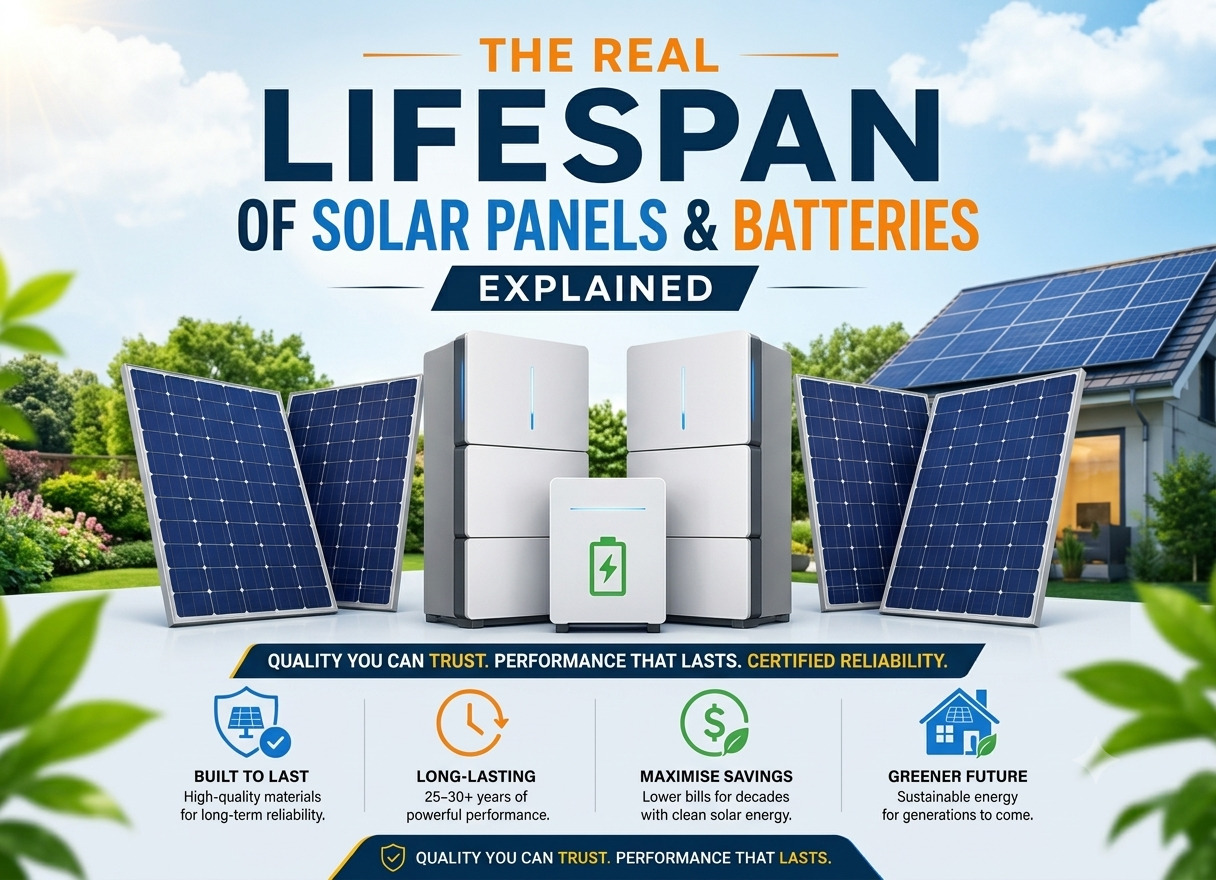
If you're considering solar, one question matters more than almost any other: how long do solar panels last? It is a common question for anyone planning a long-term investment in a rooftop system.
While savings and rebates often get the spotlight, understanding the real lifespan of your solar panels and batteries is just as important. Knowing what to expect can help you make a smarter long-term investment and get the most value from your solar system.
The answer most people get is "about 25 years." That's not wrong - but it leaves out a lot. A typical solar panel lifespan in Australia is often discussed as 25 to 30 years. Panel life expectancy describes how long before output drops below 80% of original capacity. Most quality panels hit that point somewhere between 25 and 30 years. Some keep going beyond that with gradually reduced output.
The solar panel degradation rate describes the slow decline in output - how much solar panel efficiency a panel loses each year. A decent panel degrades at around 0.5% annually. After 25 years you're still sitting at roughly 87% output. For something sitting through Australian summers and hailstorms, that's genuinely good performance. Cheaper panels can degrade at 1% or more per year. Over two decades that gap adds up to thousands of lost kilowatt hours. Solar panel durability matters far more than the upfront price tag. Check the solar panel warranty in Australia for both the product term and the performance guarantee, since they cover different things.
Solar panel maintenance sounds complicated. It isn't. Panels are low-maintenance - but low-maintenance and zero-maintenance are two different things.
The Australian Climate Factor
For anyone with solar panels in Australia, the environment throws real challenges at you.
Intense UV, coastal salt air, heavy inland dust, and the occasional hailstorm all take a toll. Panels in Townsville take a harder beating than panels in Melbourne.
Proper certifications and tempered glass aren't just marketing - they genuinely matter here.
Installation Quality Counts
A poorly mounted panel develops problems faster than one installed correctly. Micro-cracks form from vibration and thermal expansion when framing isn't done right. Choosing a good installer matters just as much as choosing a good panel. If inspection shows persistent faults or severe output loss, ask a qualified installer when to replace solar panels rather than relying on age alone.
Basic Upkeep Goes a Long Way
Dust, bird droppings, leaves in corners -none of it sounds dramatic, but it quietly chips away at output. A gentle rinse every six months is honestly all it takes in most cases.
Before investing in solar storage, understand how long solar batteries last and how use, temperature and battery chemistry affect service life.
Most buyers don't think about this until it's too late.
The solar battery lifespan in Australia and panel lifespan run on completely different clocks - don't treat them the same.
Solar battery life expectancy falls somewhere between 5 and 15 years depending on battery chemistry, daily usage and your local climate.
Solar battery life is measured in cycles - one full charge and discharge is one cycle. A decent lithium iron phosphate battery manages around 4,000 to 6,000 cycles, which works out to roughly 11 to 16 years of daily use.
Run it hard in extreme heat and that number comes down faster than you'd think.
A solar battery warranty can look solid on paper and still leave you exposed if you don't read it carefully.
Most decent warranties promise around 70% capacity retention after 10 years or a set number of cycles - whichever comes first. That last part catches a lot of people out. If your daily usage is heavier than average, you could hit the cycle limit years before the time limit runs out.
Also check the operating temperature requirements. Some warranties become void if the battery regularly runs outside a certain temperature range — which in parts of Australia is less unlikely than it sounds.
Nobody wants to think about future costs right after going solar. But the solar battery replacement cost in Australia is worth factoring in early. For a practical guide to storage value, see whether a solar battery is worth it for your household.
If your panels run 25 to 30 years and your solar battery lifespan is shorter, you may replace the battery at least once. The solar inverter lifespan is another timeline to plan for; see our guide to solar inverters for more on inverter options and service life. Possibly twice. That's just the reality of how the technology works right now.
In Australia, battery replacement costs can vary substantially by brand, capacity and installation requirements. Get an up-to-date quote for solar battery replacement cost Australia rather than relying on an old estimate. Prices are coming down steadily, so a future replacement will likely cost less in real terms. But it's still a real number that deserves a spot in your long-term budget.
When comparing the best solar batteries in Australia - Tesla Powerwall, BYD and Sungrow are names that come up consistently - don't just chase specs. Solar battery warranty depth and local after-sales support matter just as much when something needs attention five or ten years down the track.
Your panels and your battery run on two different timelines - simple as that. Panels can keep producing for decades, though output gradually declines. A solar panel replacement cost in Australia depends on whether you need individual modules, repairs or a broader system upgrade, so get an itemised assessment before replacing equipment. Batteries work harder and will need replacing at some point.
A smart solar setup plans for both from day one. Right panels, right battery, basic solar panel maintenance, and no surprises down the track.
Going solar in Australia is absolutely worth it - just make sure you understand what you're buying and how long each part of it is built to last. Ask the right questions upfront. It always saves headaches later.