22 July, 2026
| Mark
Barot


1. Introduction
2. Start With What You're Actually Using
3. Working Out the Numbers
4. Australia's Sunshine Isn't Uniform
5. Should You Add a Battery?
6. Don't Ignore the Rest of the House
7. So What's the Best Fit?
8. How Many Panels Does That Actually Mean?
9. The Payoff
10.Conclusion
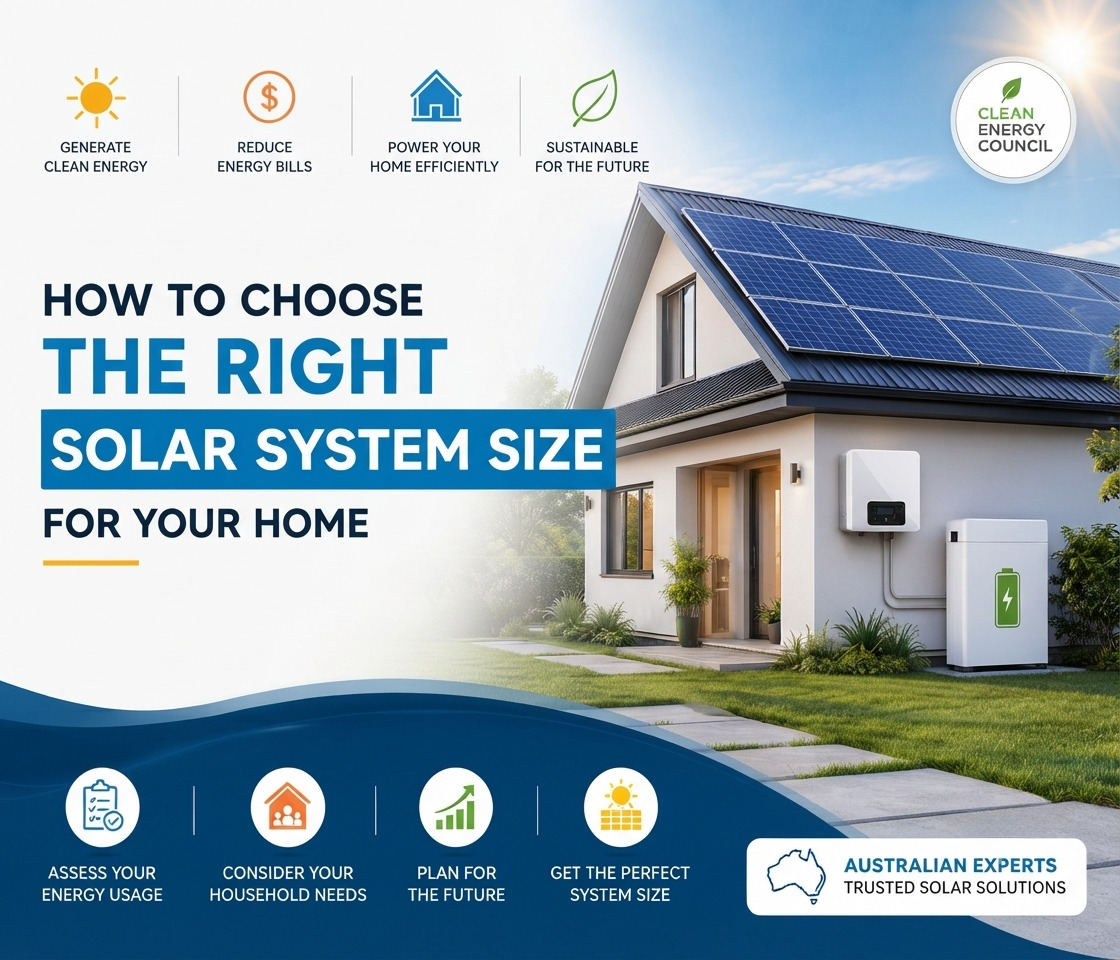
If you've started looking into solar panels for your house, you've probably noticed something frustrating pretty quickly - every installer seems to recommend a different solar system size. One quote says 5kW is plenty, another pushes 10kW and you're left wondering who's actually right. The truth is, there's no universal answer here. The right size depends entirely on your household, your roof and how you actually use electricity day to day.
Let's break this down in a way that actually makes sense, without the sales pitch.
Before anyone can tell you what size solar energy system you need, you need to know your own numbers.
Dig up your electricity bills from the past year — not just one month, all twelve.
Why a full year? Because your usage in January isn't the same as your usage in July.
Summer air conditioning and winter heating can swing your consumption quite a bit and if you only look at one season, you'll end up sizing your system for the wrong reality.
Most retailers let you check this online now too, so if you've tossed your paper bills, don't panic.
A quick login to your provider's app usually shows monthly and even daily usage in kWh.
Once you've got your average daily usage, figuring out your solar panel capacity gets a lot less mysterious.
The Rough Math
Take your daily kWh usage and divide it by the peak sun hours your area typically gets. Then add a bit extra - usually 15 to 20% - because panels never perform at their absolute rated output in real-world conditions. Dust, heat, cloud cover, it all chips away at efficiency.
So say your home uses about 20 units a day and you get 5 hours of strong sun. You're probably looking at something in the 5-6kW range once you account for those losses.
About That Output Number
Here's something a lot of people don't realise until after installation - the solar panel output printed on the box is basically a best-case scenario.
Your actual production will vary based on which way your roof faces, whether a tree shades part of it in the afternoon and even how clean the panels are.
This is exactly why it pays to size a little above your bare minimum rather than cutting it too close.
Here's where a lot of guides get lazy. They'll tell you solar panels Australia wide all perform roughly the same because "we get so much sun." Not quite true.
A house in Brisbane or Perth is going to soak up noticeably more consistent sunlight than one in Hobart or parts of southern Victoria.
Roof pitch, direction and local weather patterns all shift the equation, so what works for your cousin in Adelaide might not work for you in Melbourne.
It's genuinely worth getting someone to look at your actual roof rather than just going off national averages.
This is where things get more interesting. Solar battery storage completely changes how you should size your system. Without one, any power you generate but don't use during the day just flows back to the grid - sometimes for a decent credit, sometimes for next to nothing, depending on your retailer's feed-in tariff. With a battery, that surplus gets stored and used at night instead, which can make a real dent in your bill.
If you're planning to add a battery down the track, it's smart to size your panels a touch larger now so the battery actually gets filled properly, even on grey days.
If your home already runs efficiently - decent insulation, LED bulbs, newer appliances - you honestly might get away with a smaller system than the neighbour with the same size house but an ancient fridge and no ceiling insulation. Before you lock in a system size, it's worth asking whether a few small changes around the house could lower your usage first. Sometimes an energy-efficient home needs a noticeably smaller (and cheaper) solar setup than one that's leaking energy everywhere.
People constantly ask what the best solar system for home use actually looks like, expecting a single number. There isn't one. It comes down to your daily usage, your roof space, your local sun exposure, whether battery storage is in the picture and what you're comfortable spending. For a lot of Australian households, that lands somewhere between 5kW and 10kW - though bigger families or homes charging an EV, often need more.
A question I hear all the time: how many solar panels do I need for that kind of system? Take your target kW size and divide it by your chosen panel's wattage - most sit between 400W and 450W these days. A 6.6kW system, for instance, usually works out to around 15 to 17 panels, give or take.
At the end of the day, getting the size right is what determines your actual solar power savings. Go too small and you're still paying the grid every month. Go too big and you've overspent on capacity collecting dust on your roof.
Picking the right solar system size really comes down to knowing your own home rather than copying someone else's setup. Look at your real electricity use, understand what your residential solar system needs to cover, factor in your local conditions and decide early whether battery storage fits your plans. Do that groundwork properly and you'll end up with a system that actually pays for itself - instead of one you're stuck explaining to yourself for the next fifteen years.