18 June, 2026
| Mark
Barot


1. Introduction
2. NSW Home Energy Saver Program (2026)
3. What Is the NSW Home Energy Saver Program?
4. Who Is Eligible for the $15,000 No-Interest Loan?
5. What Energy Upgrades Can Be Funded?
6. How the NSW Home Energy Saver Program Works With Solar Battery Rebates
7. How Much Can NSW Households Save on Energy Bills?
8. How to Apply for the NSW Home Energy Saver Program
9. Why Now Is the Best Time to Upgrade Your Home Energy System
10. Conclusion
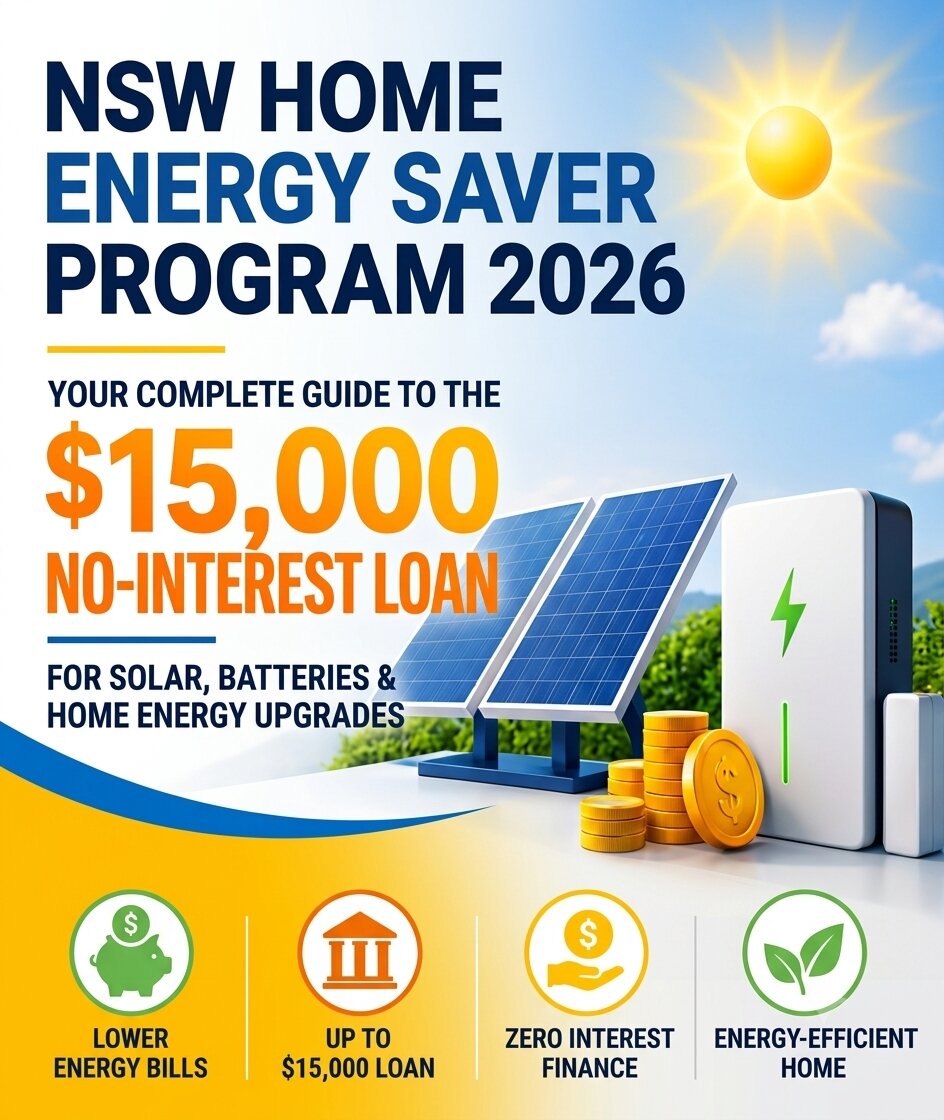
Rising electricity prices have made energy upgrades like solar panels and home batteries more important than ever for NSW households - but the upfront cost has kept many families locked out. That's exactly the gap the NSW Government's new Home Energy Saver Program is designed to close.
Launched on 17 June 2026, this $557 million initiative gives eligible households access to zero-interest loans of up to $15,000, along with additional discounts coming later in the year. Here's everything you need to know.
The NSW Government has launched the $557 million Home Energy Saver Program to help households reduce energy bills.
Eligible NSW households can access up to $15,000 in zero-interest loans for energy-saving upgrades.
Loans can be repaid over up to 10 years, making upgrades more affordable.
Available to households with a combined taxable income of up to $210,000 per year.
Additional discounts of up to $4,000 will be available later in 2026 for eligible households.
Designed to reduce the upfront cost of energy-efficient home improvements.
Expected to support more than 32,000 NSW households.
Overview of the program
The Home Energy Saver Program is a NSW Government initiative that helps households finance energy-saving home upgrades without paying the full cost upfront. It's split into two parts: a zero-interest loan available right now, and a targeted discount opening later in 2026. Of the $557 million total funding, $480 million has been allocated to the loan scheme and $77 million to the discount scheme.
The loans are delivered through two approved finance providers, Brighte and Plenti, while the upcoming discount will be administered by Creditex.
Purpose and benefits for NSW households
The program exists because energy-efficient technology - solar, batteries, heat pumps - saves money over time, but the installation cost stops many households from making the switch. By removing that upfront barrier, the NSW Government wants more families to access upgrades that make homes cooler in summer, warmer in winter, and cheaper to run year-round.
How the program helps reduce energy costs
By financing upgrades like solar panels and batteries at 0% interest, households can start saving on electricity bills immediately, while spreading the cost of the equipment over a much longer period - up to 10 years - instead of paying for it all at once.
Income requirements
Your household's combined annual taxable income must not exceed $210,000.
Property ownership criteria
The property must be located in NSW.
You must be a homeowner or landlord of the property where the upgrade is being installed.
The property cannot be social housing or used as short-stay accommodation.
NSW residency requirements
Applicants must hold Australian citizenship or permanent residency, and the upgrade must be installed at a residential property in NSW.
Eligibility for homeowners and landlords
Unlike many rebate schemes, this loan is open to both owner-occupiers and landlords, meaning rental properties can also be upgraded - provided the landlord is the applicant. Renters themselves aren't eligible for the loan, though they will be able to access the upcoming discount with their landlord's permission.
All applicants must also pass the relevant lender's standard credit assessment, since the loans are issued and managed by Brighte or Plenti under normal responsible lending obligations.
| Eligibility Criteria | Details |
| Income | Combined annual taxable household income of $210,000 or less |
| Location | Property must be located in NSW |
| Residency | Australian citizen or permanent resident |
| Ownership | Must be a homeowner or landlord of the property being upgraded |
| Credit check | Must pass standard credit assessment with Brighte or Plenti |
The loan covers a broad range of approved energy-efficiency upgrades, including:
Home battery storage systems (and solar-plus-battery packages)
EV chargers
Heat pump hot water systems
Reverse-cycle air conditioning
Ceiling insulation and draught-proofing
Induction cooktops
Energy-efficient ceiling fans
Switchboard upgrades
All products must be Clean Energy Council listed (where applicable) with a minimum 10-year warranty, and installed by an accredited installer recognised by your chosen finance provider. Battery installations specifically require a Solar Accreditation Australia installer with a Battery Storage endorsement.
Combining the loan with the Federal Cheaper Home Batteries Program
One of the most valuable aspects of this program is that it can potentially be combined with other state and federal incentives, including the federal Cheaper Home Batteries Program, the NSW Energy Savings Scheme (ESS), the NSW Peak Demand Reduction Scheme (PDRS), and Small-scale Renewable Energy Scheme (STC) rebates.
Potential savings opportunities
Eligible battery owners may also be able to access Virtual Power Plant (VPP) incentives, which pay households for letting their battery support the grid during peak demand - adding another layer of savings on top of the loan itself.
Reducing upfront installation costs
In practice, this means a household could use a federal rebate or STC to reduce the sticker price of a system, then use the NSW loan to finance the remaining balance interest-free. If you're also eligible for the upcoming $4,000 discount, the government recommends applying for the discount first, then taking out a loan to cover whatever is left.
Benefits of solar and battery storage
Store excess solar energy generated during the day for use later.
Use stored energy during peak evening periods, when grid electricity is most expensive.
Reduce dependence on grid electricity overall.
Lower electricity bills
By using more of the solar power you generate (rather than exporting it for a small feed-in tariff) and drawing less from the grid during expensive peak periods, households can meaningfully cut their day-to-day power costs.
Increased solar self-consumption
A battery lets you store unused solar output instead of losing it back to the grid, which is especially valuable for households that are out during the day and use most of their electricity in the evening.
Long-term energy savings
Combined with insulation, draught-proofing, and efficient appliances, these upgrades reduce overall household energy consumption - meaning savings continue well beyond the loan repayment period.
Step-by-step application process
1. Check your eligibility at energy.nsw.gov.au/home-energy-saver against the income, residency, and property criteria.
2. Choose your upgrade(s)and use an energy savings calculator if you're unsure which option suits your home.
3. Find an approved installer accredited with either Brighte or Plenti.
4. Get a quote from your chosen installer for the upgrade.
5. Receive a referral link - the application is typically initiated by the installer, who shares a pre-populated link to your chosen finance provider with the product and cost details already filled in.
6. Complete your application directly with Brighte or Plenti, including a serviceability assessment, then wait for approval and installation.
Required documents
Proof of property ownership (e.g. a rates notice or title document)
Household income evidence (payslips, tax returns, or Centrelink income statements)
Your electricity bill's NMI (National Meter Identifier)
Strata consent documentation, if applicable
Tenant consent documentation, if you're a landlord applying on the tenant's behalf
Choosing approved products and installers
You don't apply to Brighte or Plenti directly out of the blue - your installer needs to be accredited with one of the two providers, and your chosen products need to be on the approved list. It's worth confirming both before you commit to a quote.
Important things to check before applying
Confirm your installer is accredited with your chosen finance provider (Brighte or Plenti) - not just generally licensed.
Confirm your equipment is on the Clean Energy Council approved list
If you might qualify for the upcoming $4,000 discount, consider waiting and applying for that first before taking out a loan.
Remember loan funds are paid directly to your installer on completion of the job, not to you.
Late repayments incur a modest fee (capped at $120 total), so factor repayments into your budget.
Rising electricity prices
With electricity costs continuing to climb, the gap between households with and without solar and battery storage keeps widening. Locking in lower running costs now compounds over the life of the system.
New government support available in 2026
This is the first time NSW has offered an interest-free loan at this scale specifically for home energy upgrades, on top of existing federal rebates. That combination significantly lowers the real cost of getting started.
Improving energy independence
More than half of NSW homes already have solar, and the state is adding around 13,000 new home batteries every month. Upgrading now means joining a rapidly growing number of households reducing their reliance on the grid.
Future-proofing your home with solar and battery storage
As electricity markets shift further toward time-of-use pricing and demand-response programs, having your own generation and storage gives you more control over when and how you use power - insulating your household from future price volatility.
At the end of the day, this program won't suit every household, but for a lot of NSW families it removes the one thing that's been holding them back - the upfront bill. If you've been weighing up solar, a battery, or even just better insulation, this is probably the cheapest way you'll ever finance it. Worth a proper look before you decide either way.